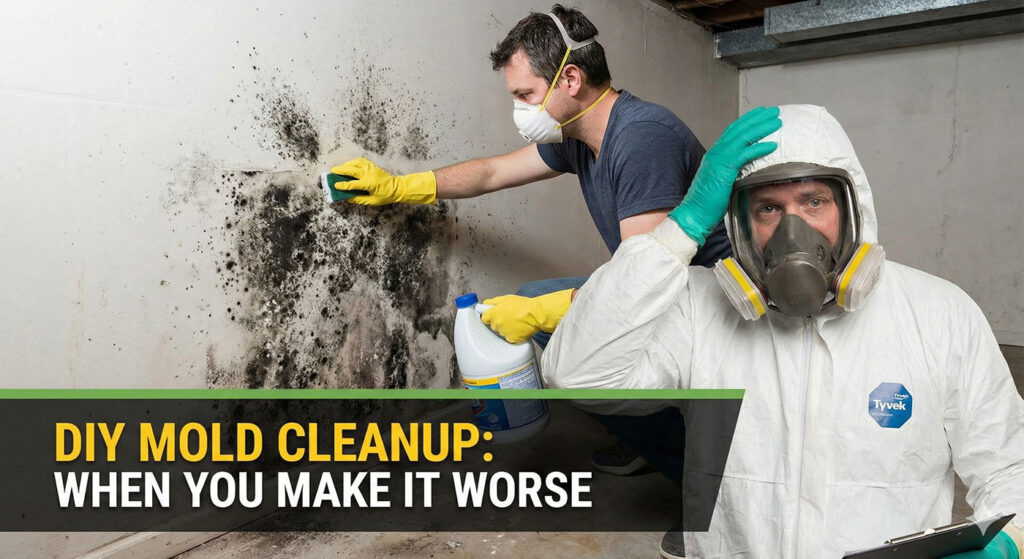

When mold shows up, it’s tempting to grab some bleach, a mask, and “handle it yourself.”
Homeowners try this every day—and most of the time, it backfires.
The truth is simple: DIY mold cleanup usually spreads the problem, hides the real source, and ends up costing you more in the long run. Here’s what property owners don’t realize until it’s too late.
Bleach is the #1 mistake.
It lightens the mold, so it looks gone, but it doesn’t penetrate porous materials—drywall, framing, insulation, baseboards, etc.
Here’s what actually happens:
It kills the surface stain, not the roots
The extra moisture from bleach soaks into the material
Mold uses that moisture to grow back even stronger
So instead of removing the problem, you just cover it long enough for it to spread inside the wall.
Any time you wipe, scrub, or disturb mold, it releases spores—microscopic particles that float through your home’s air system.
When there’s no containment, no negative air pressure, and no HEPA filtration, you’re basically blowing mold into:
Bedrooms
HVAC ducts
Closets
Behind cabinets
Connected units (in condos or townhomes)
This is why so many small mold problems turn into full-blown contamination after a “quick cleanup.”
Mold is a symptom, not a cause.
You can clean mold all day long, but unless you diagnose and fix the moisture issue, it’s coming back. The source might be:
A pinhole plumbing leak
A slow roof drip
A failing AC drainage line
Hidden condensation
Poor ventilation
Professionals use moisture meters, thermal cameras, and air sampling to find the root problem.
DIY usually just addresses what you can see on the surface.
By cutting, scrubbing, sanding, or pulling off a panel, you can expose a much larger contamination behind the wall or under the floor.
That’s when things get expensive:
Full containment
Negative air
Demolition
HEPA vacuum
Clearance testing
A $300–$500 mold issue can turn into a $3,000–$8,000 project fast when an amateur disturbs hidden growth.
Mold affects everyone differently. Some people feel nothing. Others experience:
Respiratory irritation
Persistent coughing
Allergy-like symptoms
Headaches
Fatigue
When you disturb mold without PPE and proper engineering controls, you're putting the entire household at higher risk.
Professionals use full PPE, HEPA equipment, and strict protocols for a reason.
This is something no homeowner thinks about until it's too late.
If you try to clean mold yourself and it spreads—or the damage gets worse—insurance may claim the issue was caused by improper maintenance or negligence.
Professional documentation protects you. DIY usually hurts you.
So When Is DIY Mold Cleanup Actually Okay?
There are only a few safe scenarios:
The mold is on non-porous material like tile or glass
The affected area is smaller than 10 square feet
You know the exact moisture source and have fixed it
There’s no history of water damage or hidden leaks
Even then, if you see the mold returning, don’t guess—get testing.
When You Should Call a Professional Immediately
Reach out to a licensed mold inspector or remediation company if you notice:
Musty odors
Discoloration on walls or baseboards
Allergies that flare up at home
Past water damage
Visible mold larger than a few square feet
Mold returning after DIY cleaning
Condensation or moisture you can’t explain
In these situations, professional mold testing is the safest and most accurate way to determine the source, the extent, and the right plan to fix it.
Final Word: DIY Mold Cleanup Often Creates More Damage Than It Solves
Most mold problems look small on the surface—but act big behind the scenes.
If you want to protect your home, your health, and your wallet, the smartest move is getting a professional opinion before you start scrubbing.